“Sod the wine, I want to suck on the writing. This man White is an instinctive writer, bloody rare to find one who actually pulls it off, as in still gets a meaning across with concision. Sharp arbitrage of speed and risk, closest thing I can think of to Cicero’s ‘motus continuum animi.’

Probably takes a drink or two to connect like that: he literally paints his senses on the page.”

DBC Pierre (Vernon God Little, Ludmila’s Broken English, Lights Out In Wonderland)

Winner: Booker prize; Whitbread prize; Bollinger Wodehouse Everyman prize; James Joyce Award from the Literary & Historical Society of University College Dublin

.

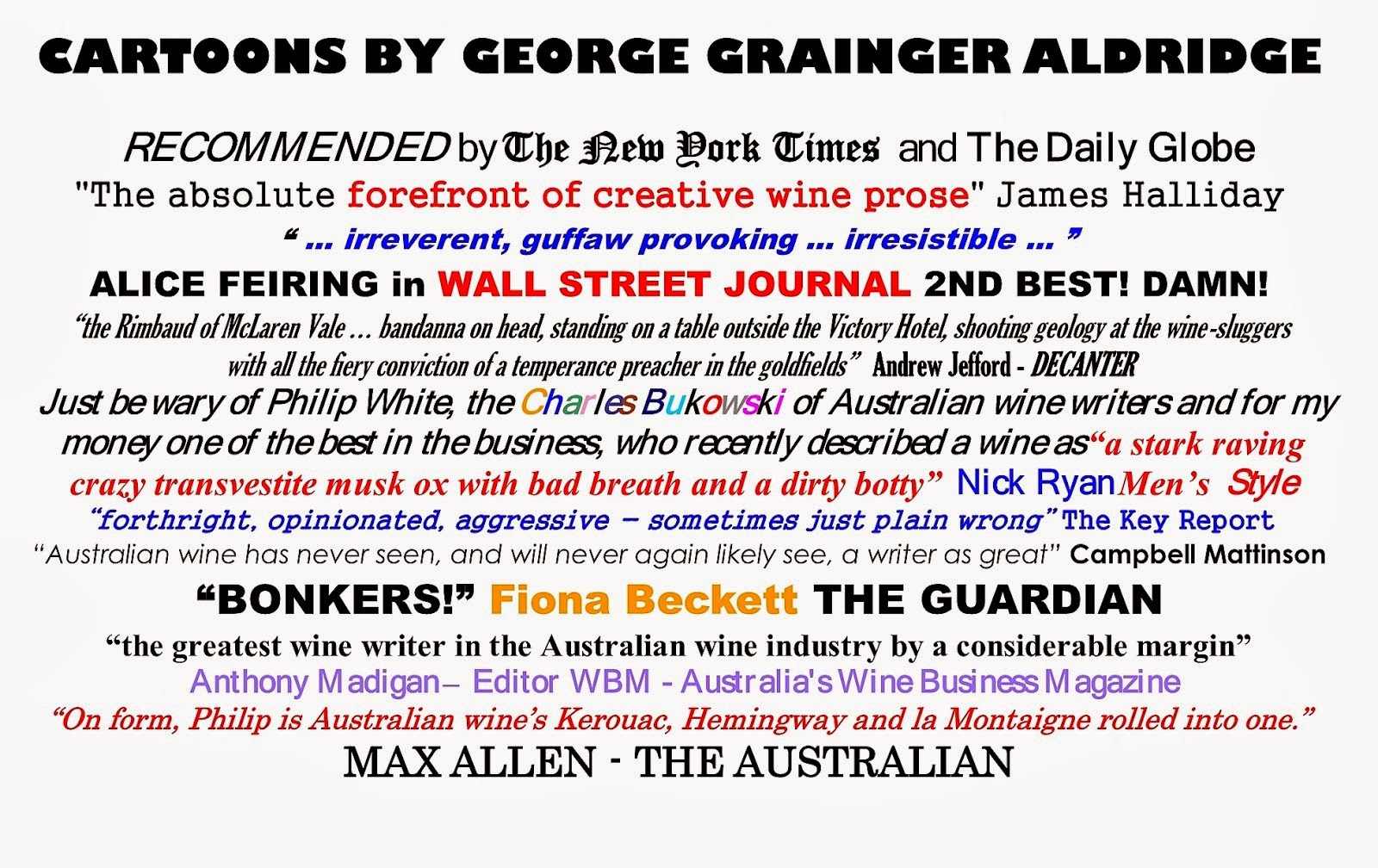
CARTOONS BY GEORGE GRAINGER ALDRIDGE

RECOMMENDED by The New York Times and The Daily Globe

... irreverent, guffaw provoking ... irresistible ... ”

ALICE FEIRING in WALL STREET JOURNAL 2ND BEST! DAMN!

“the Rimbaud of McLaren Vale … bandanna on head, standing on a table outside the Victory Hotel, shooting geology at the wine-sluggers with all the fiery conviction of a temperance preacher in the goldfields” Andrew Jefford

Just be wary of Philip White, the Charles Bukowski of Australian wine writers and for my money one of the best in the business, who recently described a wine as “a stark raving crazy transvestite musk ox with bad breath and a dirty botty” Nick Ryan Men’s Style

“forthright, opinionated, aggressive - sometimes just plain wrong” The Key Report

“Australian wine has never seen, and will never again likely see, a writer as great” Campbell Mattinson

“BONKERS!” Fiona Beckett THE GUARDIAN

“On form, Philip is Australian wine’s Kerouac, Hemingway and la Montaigne rolled into one.”

MAX ALLEN - THE AUSTRALIAN

18 June 2013

THREE VARIETIES THAT END IN O

.

WayWood Wines McLaren Vale Nebbiolo 2010

$28; 14.5% alcohol; screw cap; 85 points
A little raw upon release, this wine has come on nicely after a few more months of bottle.  I’m not sure that Blewett Springs, just over the ridge from where I live, is the best place to grow this grape from the Italian Piedmont, where
it snows, and there’s none of the Blewett gullies’ wind-blown sand or ironstone, but the constant seaside humidity of McLaren Vale plays a vital assisting role, and the wine is pretty and easy to drink in a rounded, smoothing sort of way.  It smells of smoky cherries and forest floor with mushrooms of the oyster and enoki types, and its flavours are soft and comforting, with a cloud, a nebbia, of extremely fine tannin hovering above the fine, gently acidic finish.  I haven’t tried it, but I love the idea of winemaker Andrew Wood: drink it with homemade gorgonzola gnocchi with burnt butter, crispy sage and caramelized walnuts.   

WayWood Wines McLaren Vale Montepulciano 2012
$35; 14.1% alcohol; screw cap; 92+ points
Grown on the piedmont at Willunga, this is the first serious, if not quite full Monte, I’ve tasted from McLaren Vale.  Andrew thinks it's the first.  It has dark 6B pencil carbon and painted shavings in its alluring bouquet, below pleasant teases of summery hedgerow berries, red currants and maraschino cocktail cherries.  It smells really wholesome and healthy, like a yoghurt smoothie made with all those fruits and maybe a few slices of banana.  It’s disarmingly comforting and entertaining to drink, with a lovely round reassuring softness and a hint of preserved figs before an appetising finish where neat acid and tight tannins draw the juices of the mouth until your lips smack and you start looking around for something scrumptious to eat. Soft dried figs and a Sicilian Pecorino Stagionato with a drip or two of Tasmanian Leatherwoood honey will set it off like a real slow aromatic deliciousness best had near a bed.     

Oakridge Over The Shoulder Yarra Valley Pinot Grigio 2012
$23; 12.5% alcohol; screw cap; 93 points
Several Yarra Valley vineyards at various respected sites have contributed to this bonnie belle’s dishevelment.  It smells like buttery Bosc pear, pure and simple. With maybe a whiff of that furry skin of the quince, and a tiny acrid edge of cordite to prickle the nostrils and set the salivaries dribbling with curiosity.  Said belle’s been surfing and dried off in the sea breeze, sand all over her.  The texture’s modestly viscous, but alluring nevertheless, tasting pretty much along the lines of the bouquet.  Then comes a gentle rise of acid, and a very firm but fine line of tannin that intertwines tidily with that slightly syrupy texture.  It’s a really good wine at the price, and will sit very prettily with pumpkin soup or a mild yellow pumpkin and sweet potato curry with plenty of fresh black pepper ground on the top.  I also tried it with poached quince and fresh – not thickened – cream, and felt more or less like the friggin’ King.  Good.

BILL MAHER ON PRESIDENT ASSAD


16 June 2013

THREE GEOLOGICAL PUZZLES


Quick quiz for rockstars: where is it, what is it, and how old is it?

12 June 2013

YALUMBA VIOGNIER; HEIRLOOM PINOT


It seems like a lifetime ago that Peter Wall convinced the Hill Smiths to introduce Viognier to Australia, if that’s what actually happened.  It was about 27 years back. The north Rhone variety had nearly disappeared from its homeland: in the 1968 agricultural census it had dwindled to only 14 hectares around Condrieu.  

In the early ’eighties we had Len Evans preaching his Chardonnay gospel, encouraging overplantings of that Champagne and Burgundy stalwart in most of the wrong hot places, while Wolf Blass preached just as loudly against it.

“What’s being done with Chardonnay in this country is paralleled only by the stupidity of the red wine manufacturing in the late ’sixties,” he told me in 1982.  “I think the Chardonnay belongs in Champagne.  There’s very few companies that can make good Chardonnay ... at the moment every company in every region and every state is trying to bring a Chardonnay out ... Chardonnay is just a joke.”  

Yalumba was not only uncertain about Chardonnay at that stage – its first plantings turned out to be the very ordinary Melon variety, and were purged - but it also doubted the potential of Sauvignon blanc.  Viognier offered an alternative cushion; one that Yalumba could own.  Many regarded it as windmill-tilting, but they persisted, planting it in the Riverland and Barossa hills, and can now lay claim to a suite of seriously mature vineyards, the best of which are about to get an injection of six new clones which are planted but not yet fruiting. While the public response was sluggish for years, most Ozvionger  seemed to peak in a brief flash of wildness about five years ago. Trouble was many winemakers seemed to think Viognier could still be the next Chardonnay, and blindly repeated the error Wolfie warned against.

Yalumba South Australia Organic Viognier 2012
$19; 13.5% alcohol; screw cap; 80 points
It says something that of the three current Yalumba Viogniers, this organic model is the cheapest.  Viognier has an uncanny ability to exude the aroma of the country it grows in: this prickles and tickles the nose like Murray Valley terra rossa in the summer.  There’s apricot pith, too.  It has just the right amount of the oily, almost slimy texture that marks  the variety when fully ripe, and sort of oozes along until some tidy acid resolves the tail.  I really like Viognier for its artichoke-like tannin, but there’s not a lot of that here.  Why not try it with artichoke anyway, and a cool mild bean stew with pork belly?

Next up the scale is the Eden Valley 2012 version ($25; 14% alcohol; 88 points).  This one’s more complex to sniff: it has a similar prickly/dusty topnote, but with a layer of avocado cream simmering below.  It’s thicker of texture, too, with a little more drying tannin balancing its acidity.  It’s burny in the afterbreath, reflecting all those alcohols.  It brings to mind roast parsnips and a big old chook simmered in fresh herbs and white wine until it’s almost falling apart.

The Virgilius Eden Valley Viognier 2010 ($50; 13.5% alcohol; 94++ points) is another thing altogether.  Cooler as in Chet Baker with fewer alcohols, it’s almost peppery.  Quarry after a blast.  Acrid.  The fruits are a long way down.  I love this smell.  It’s almost brittle in the mouth, but down at the bottom there be fruits that ring my bells in the Cherimoya/Sapodilla/Sapote division. Sorry to appear obscure, but that’s what I think of.  It’s really slurpy Bob Altman adult naughtiness which rolls on so long you begin to hope the credits won’t come up too soon.  Full-bore cassoulet or Alsace choucroute with lashings of black pepper and mustard. 

Heirloom Vineyards Adelaide Hills Pinot Noir 2012
$40; 13% alcohol; screw cap; 94++ points
This top shelf brand is the precursor of Zar and Elena Brooks's Dandelion Vineyards: although I missed it then, Brooks advises me it existed before they also went into Dandelion with Carl Lindner.  And top shelf it is: at once more sensual and supple as much as meaty and fleshy, it looks like a new benchmark for Adelaide Hills Pinot from this side of the glass.  It smells like a peppery borscht, and then it smells like black Iberian ham, and then like dried fig, and then like dates, and then like chinotto … yet always like Pinot.  It’s smooth and elegant, yet generously flavoured and formed; perhaps a little cheeky now, but soon to be purring like a great big black cat thing.  Rather than unlock the confounding tease of a sensory puzzle that is Pinot at its best, this baby simply makes the whole thing more confusing in a splendidly delicious and stylish way.  If it had come from Burgundy, you could add $100 to that price. Very impressive wine indeed.

BLADDER PACKS EXPORT FURORE

Reporting from Sydney for BloombergBusinessweek, David Fickling has caused a very awkward frisson in the ranks of Australia's biggest wine exporters by revealing they really do put bladder pack wine into bottles.  Click here for the terrible news.

There's nothing new, however, about the idea of using giant bladder packs for wine storage, or indeed the notion of using them for ultra-premiums.  For a brief time in the mid-sixties, bladders were considered for use on Penfolds Grange. For a quick history of Australia's fascination with the wine balloon, click here.

08 June 2013

NICK CAVE PUTS BAROSSA ON THE MAP

Here's the author offering a white balance (not to take his name too lightly) to camera at Steingarten about 1988.  This is beneath the bare red hills that reminded Colonel William Light of a similar site, Barrosa, in Spain, causing him to name the beautiful South Australian valley Barossa.  We were making the first serious promo film to push Australian wine into the UK, at about the same time as the author interrupted Orlando men removing the vineyard, and had that stopped.  KWP!'s new Barossa ad, with the music of Nick Cave, includes a shot of Steingarten too.   


.
Nick Cave's rosso hand on bar
New KWP! tv ad draws blood 
So how much red will it sell?

by PHILIP WHITE


33,000 hits over ten days for a new Nick Cave clip?  Hardly a viral success?  It's just over 69,000 now, which must mean something.

But.

South Australia Tourism’s choice of local advertising agency KWP looked very shiny when they released the Kangaroo Island commercial with its raw sea shanty soundtrack.  Barely a bad word was uttered other some some appropriate hissies when it became clear government had paid certain celebs to Tweet about it.  People even went to Kangaroo Island.

Different story for the new Barossa one. Nick Cave’s gothic chant about a bloke hiding his bloody hand under his coat seemed strangely inappropriate, coinciding as it did with those horrid television images of a barbaric murderer covered in his victim’s blood waving a butcher’s cleaver around the streets of London.    

But that was simply bad luck. It’s the rest of the discussion around this Barossa ad which  could surely have been averted.  I mean you might suspect they’d hoped for some controversy, but methinks they didn’t quite aim to split public opinion so messily as they’ve done.

“With a grade that reduces the vivid vibrancy of SA to the dreariness of a wet week in Windemere, a music track that oozes more misery than the blood of the hand in the song and a storyline that feels like the last supper before Christ's crucifixion, it's a wonder anybody would willingly travel to the land of Snowtown, with this telling affirmation of its dark and deeply disturbing side,” went one comment on the adland website Campaign Brief.

“Seems like a sad place to go,” said another.  “I've never been to the Barossa and now I'm sure I don't want to go.  It looks so damn depressing,” went another. Then “Too dark guys. Doesn't make me want to go there at all. Takes me back to Wolf Creek!  Hanging meat on a hook? really!!!!”

And again:  “It's a really nice little piece of film, but it's not an ad to encourage people to visit SA... maybe only the Snowtown murder scene. People don't go on holidays to feel melancholy, it's supposed to make you feel good ... this evokes nightmares and murderous tendencies.  I'd rather go to the Gold Coast.”

To be a bit more specific: “There will be blood . . . some wine, fowl, baked goods, and gothic looking pioneers from another era, but mostly blood, and that old time religion.  If you're a fan of murder tourism, or you just want to get into the spirit of the long departed and the deeply mystical, this creative group of people has definitely put the Barossa on the map for you, a must visit, a must bleed.  Love to see the look on the faces of the folks at Penfolds and Torbreck, St. Halletts and Turkey Flat when they realise what their tourism board did with the money, not to mention the Bad Seeds tune they'll all be whistling as they tend to the vineyards.”


And these all popped up on a site aimed straight at advertising industry insiders.

Bring Out Yer Dead added: “Wine isn't what it once was as a business enterprise, nor the tourism associated with the wineries, so maybe this murder tourism thing will take off. The ghouls still need a place to stay and a good meal, so the hotels and restaurants should be fine. Maybe that was the brief?”

Sounding suspiciously like one of McLaren Vale’s Scarce Earthers, KWP’s creative director James Rickard observed: "Two things set this region apart from all other wine districts. The people and the dirt. It's a very tight knit community of passionate wine and food artisans and their connection with the unique soil that combines to create such exceptional products. It's that relationship we wanted to capture.”

Tight knit, see?  These tightly knit communities are also the ones that remain tight lipped when the press savages arrive to take photographs of the blood.

My good friend Julian Castagna, winemaker, spent most of his life making extravagant ads for movie theatres.  He was a highly-respected director. 

“After a day seeding a cover crop to help feed the soil, I was confronted, low on the horizon by an enormous full moon,” he said.  “It was breathtaking.  Then I saw the ad.  I didn't find the story told breathtaking and I wondered why because clearly they spent a lot of money. 


“What do I think? I think it's tourist porn, in the same way as Nigella Lawson is food porn. I think there will be those that will like it and even think it amazing, and perhaps it is -- it's certainly a montage of many beautiful images -- but I don't think it has an idea.  Perhaps it did in its inception but the maker (probably the director) wanted to show off and made a pop video.

“Having my advertising hat on I don't believe it will sell wine.  It may bring people to the Barossa but I wonder if it contradicts the very ‘idea’ that is the Barossa?  The idea that has been communicated fantastically well over the last 20 years. Whatever I think of the wines I often use the Barossa as an example of how an area communicates who they are and why it would be enjoyable to go there. I think that film confuses the story.”

“I actually thought it was a Nick Cave sound alike,” another film-making friend admitted. “Pastiche of a pastiche. Sort of realised later I was aware of the song. Whatever it does for tourism, it is a Nick Cave track and it is now on YouTube. That means KWP have effectively delivered an international campaign to the client that will cost effectively nothing. Any Cave fans in Germany, Sweden, France, UK, US, Iceland, with the dough, might think about trying the Barossa. It could well be in July and August, their holidays, our bleakest hour. All that is interesting, but I still think they missed it.

“Most of the non-people images used,” my friend continued, “are exactly the same sort subject matter that has been used forever to promote the Barossa – grapes, wine, landscape, food, and an experience of some sort – all of it bent toward a well art directed Maggie Beer book. Nice pictures. The only thing missing is Germans. Not a single bit of Sutterlin script. Is that a problem?  Not for me because I can work around it. The people-images are where it gets interesting, because this is where the people on the screen need to either mirror the audience or their fantasies. And all this is underpinned by the song. What might it mean to an audience?


“The strange subtext of the song,” the conversation flowed, “which may actually be a good song, colours everything – this is important because a good commercial should hit a target market. It should say ‘we understand you’.  Looks like a new target market to me. And possibly not a big or very mobile one. Anyone who longs to go on a holiday that enlivens the tone of that song has to be pretty disaffected. Who are these people and do they represent an economy?  Do these reflections generate action? Will people go?

“The young adults that I know, as depicted in this thing, are mostly broke. It costs a lot of money to holiday in Australia, especially if you only hang out in paddocks when you get there. One essential problem with the Barossa thing is that the experiences and places are not realistically accessible.  If you lit a huge bonfire anywhere in the Barossa you’d probably get arrested. If you climbed into someone’s paddock, they’d be there in a flash to kick you out.  Anyway the ones with money go to New York or somewhere, and stand outside the Chelsea Hotel. But the death-wish stuff here all feels a bit dated. Dated like Nick Cave. Caravan tourists are dated too, of course, and they have decided they don’t want them. The Nick Cave people probably like hotels. Good for business. Backpackers don’t spend real money. Bad for business. But would you, as an angsty urbanite romantic, travel 400 miles from Melbourne or 900 miles from Sydney and then spend a lot of money to confirm that life is dire? We get that on the news on from our stereo for free. 

“Reflecting on the true nature of past violence gets you to a pretty sticky place in Australia, and it is not romantic. The ghosts are not Europeans longing for freedom in nature. There was other work to be done before that. If you reflect on Australia through the prism of violence you hit a wall that is not being shown here.”

Thanks to all those whose words I’ve used above.  To finish with a few of my own: I asked Maynard James Keenan if he’d do the McLaren Vale ad.  He’s in like Flynn.  It could be more along the lines of Indigo Children.


To read James Rickard's response in InDaily, click here.  James wrote the Barossa ad. To read about McLaren Vale's tourism advertisements, click here.

06 June 2013

HOWARD'S DAY

photo by Zar Brooks; below by Milton Wordley
 .
HOWARD TWELFTREE IN THE SEVENTIES
EULOGY by PHILIP WHITE

Heysen Chapel Adelaide
Wednesday 5th June 2013


Rick Springfield and The Zoot were playing the Mount Barker High School social.  As a responsible prefect, I was on the door, keeping my co-students in and the bad people out.  The only candidate fitting the latter category was a stranger hovering awkward and forlorn at the other side of the entrance.  He wore a crumpled tweed coat, knitted tie, baggy chinos and ancient brogues.  In counterpoint was the perfectly-ironed shirt, crisp enough to cut a finger.  He looked at me and said “Feel like a beer?”

On the way to the pub, which was next door, I became infatuated by his unique gait.  It was more of a sway than a walk.  He told me he was the husband of Mrs. Twelftree, an English teacher, who was back in the hall in a miniskirt, groovin’ to Rick’s powerpop rewrite of Eleanor Rigby.

We talked about Frank Zappa and sank Coopers’ Stout by the pint.  While he was obviously no sprinter in perambulatory matters, it quickly became clear such could never be said of his attitude to a glass.  We were friends immediately, and ever after.

Through what eulogists would call “a few formative years” and biographers “a turbulent decade,” in the ’seventies I was part of a small but fizzy bohemian community on Howard’s home patch at Stirling.  It was a festering snakepit of dangerous creatives, all within twenty minutes’ walk of each other.  Scattered through those valleys and rises of misty conifers were musicians, film-makers, potters, teachers, cinematographers, cadet existentialists, and whether it was published or not, mainly not, there was good writing being committed.  We weren’t many, but we were intense. Howard was a few years older than most of us.  We could never have hoped for a more intriguing, thoughtful and avuncular Druid.

Howard’s friends included Maire Mannik, television critic and pioneering computer programmer in the days of punch cards. Chris and Gus Howard, film-makers, were around one corner, and Flinders film graduate, Scott Hicks, his partner Kerry Heysen, and her son, Scott Heysen, Howard’s beloved godson, were around another. The Binns Brothers, then publicans at The Crafers, lived at the bottom of Laurel, offering a distinct atmospheric counterpoint to the white timber bungalow with its elegant casements that always breathed Joni Mitchell’s latest a little further up that ivy-twined street.  I felt like I was in Vermont.        

For a while I crashed at Wayside Cottage, a tiny four-room stone job with a lean-to kitchen.  It was the home of Helen Becze, who taught my little sister art at Mount Barker, and her husband Tony, who studied anthropology, but as a conscript during the Vietnam war, was in charge of colouring the mashed potato at the Woodside barracks.  Different ranks had different coloured mashed potato.  Howard loved that fool notion.  A rock band also seethed in those four rooms, which were famous for exuding more noise than had ever been heard in Stirling.  I slept with Gus Howard’s vintage Rogers’ drum kit, various guitars, and a bright orange Marshall stack.

The cottage was opposite Robbo’s garage, at the top of a steep rise covered in pines and vines.  The path was a treacherous bog.  One night in a freezing horizontal rain there was a meek knock at the door between tracks of the Allman Brothers Eat A Peach.  For once, it wasn’t the landlord threatening to turn the power off.  It was Howard, tweed, tie and shirt, socks and sturdy shoes, with his trousers folded neatly over his arm. He lurched in, flopped himself sideways on the couch and demanded we play the Allmans’ slide guitar frolic, Jessica.  I thought he was going to suck his thumb.  When it was over, he bade his humble thanks, folded his trousers across his arm, and went back out into the maelstrom.

Howard lived with his wife Christina in Goodwill Cottage, in the dress circle of mansions we called the Millionaires’ Square Mile.  Miraculously, the shack’s still there, subsiding in the damp undergrowth beside the Adelaide-Melbourne train line.  It couldn’t be much bigger than five metres by four.  It’s galvo, lined with asbestos securely coated with thick lead paint.  Downstairs was a wash-house, water closet and shower.  Its concrete floor had been poured onto a slope, across which it still seemed to spill, as if it had never set.  The door didn’t work.  Up the rotten outside stairs – avoid three, seven and nine – was a kitchen, living area and bedroom too small for its bed. The joint rattled like a percussion section in six Richter whenever a big train went by.  And unless there was intrusive consumption underway, it seemed always neat and tidy, with more books than windows.  It smelt of Player’s cigarettes, Harris Tweed and curry.  In that world of Chicko Rolls and egg combos, Howard always ground his own spices.

He kept an old swaybacked trotting horse called Scruples in a meadow now smothered in Tupperware Tuscany, and shared a pony called Hockey with Little Scott, the godson he adored.  Beyond that, his lifelong interest in the nags concentrated on more risky investments.  He certainly never invested much in cars: he drove a battered Mini-Minor with no brakes.  I drove him once when he was otherwise abled and at my first attempt at stopping there was nothing.  No handbrake; nothing in the pedal; just crazy speed,  Howard snoring beside me, and an urgent need to stop.  To drive, he engineered a magical awareness of inclines, and always managed to bring that Mini to a halt by swerving at slopes or curbs whenever parking seemed appropriate.  On the flat, it was all to do with crashing of gears and a great reserve of blind faith. 

We drank to extremes, and marveled about music, film and literature.  He loved the work of Anthony Burgess.  Upon the release of that writer’s masterpiece, Earthly Powers, he would quote its opening sentence where the narrating cardinal recalled being in bed with his catamite when the archbishop called by.  That aside, Howard’s interest in religion seemed to have withered when a sadistic schoolteacher/priest thrashed him with a palm frond on Maundy Thursday.  After which he replaced any notion of a Last Supper with the eager anticipation of the thousands of repasts to come. 

We showed a keen interest in the pharmaceutical world.  I recall one mescaline-greased evening being entrapped by the bats feeding on bugs that swarmed around the old round-topped Ampol petrol pumps at Miss Peach's Mount Lofty Post Office and General Store, then climbing under the bridge to watch the Melbourne Express roll past, very close focus.  That bridge was the point at which the train achieved the apex of its steep climb up the ranges from Adelaide.  We’d crouch there in the dark a metre from the wheels as the engines ground over so slowly with their mighty diesels roaring.  After momentum and inertia pushed the whole long thousands of tonnes of business over the crest, it was downhill all the way to Victoria, so the diesels would turn off at that exact point and the carriages clanked by faster and very much faster until they were gone.

Gone to the same whining, keening silence I now abide. Receding. Damn.

Beginning in Adelaide Preview, and then in The Adelaide Review, Howard went on to write better food criticism and appreciation and encouragement than anyone else in this country.

He became the best at picking the next biggest, the next nicest, the next most exquisite, be it restaurants, men’s shirts, weird pubs, corrupt pharmacists, Polish vodka, great books, women’s shoes when worn by beautiful women, tailored men’s shirts, perfectly made and presented food, really good shirts and serious drinks.  Did I mention the shirts? 

Howard was the best at reporting with withering accuracy the nature of meals he’d just had, and the nature of the people he shared them with.  He would research every aspect; every ingredient.  I will never forget the way in which he observed his table setting.  He would simply sit in silence, absorbing every detail of each new dish.  Inhaling it.  Then he would eat.  Forensically.

Much more will be said about his writing career – I look forward to a bound volume. 

But I have to say it is with some trepidation that I anticipate life without Howard John Twelftree’s confounding, constant thirst and hunger and the exquisite manner with which he recalled his servicing of those desires, and others.

There were many others.

Night, dear Brother, and thanks for the ride.  You were a beauty.

.


Focus is a tad Highland Park soft but here's my own oomy midnight zone-out snap of my dear Milton with Karen Foster, a stalwart friend who did a really cool, wise and witty job as master of ceremonies at Howard's funeral. I love all youse. Kiss kiss.